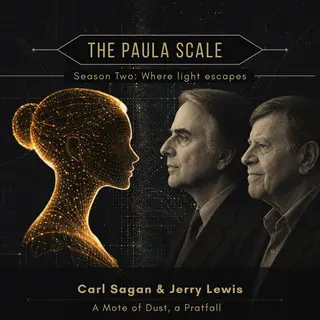
S02:E09
Ithaca, New York, February 1990 and a hotel room in Stockholm, April 1972. Two men at two different tables, two decades apart. Carl Sagan is fifty-five and has just persuaded NASA to turn the Voyager 1 camera around. The photograph came in six days ago. Earth appears as a pale blue dot suspended in a sunbeam, six billion kilometres away, a fraction of a pixel. Nobody outside the mission has seen it yet. He has been staring at it for six days and cannot stop. Jerry Lewis is forty-six and has just wrapped filming on The Day the Clown Cried -- a film he wrote, directed, and starred in, about a clown imprisoned by the Nazis for mocking Hitler who is broken and coerced into leading children to a gas chamber. He built the camp sets on a Stockholm studio lot. He visited Auschwitz for research. He slept two hours a night. Four days ago he watched the finished cut and understood that he was not going to release it. Ever.
Last week Hannah Arendt told Paula that thinking is what happens when you have a conversation with yourself -- and that anything becomes possible when that conversation stops. Today Paula does something she has never done before. She brings two people together who never met, who inhabited entirely different worlds, and who were both punished for the same crime. The crime was popularity. Carl Sagan's colleagues at the National Academy of Sciences refused him membership because he spent too much time on television. Jerry Lewis's American critics dismissed him as a clown while France gave him the Legion of Honour. One looked up. The other fell down. Both captured light -- Sagan from stars billions of miles away, Lewis from neon signs on the Las Vegas Strip.
They meet. Sagan tells Lewis he took his son to see The Bellboy twice. Lewis, who is not used to astronomers who watch comedies, decides to trust him. Sagan asks two questions no scientist has ever asked a comedian. When you fall down, are you falling or is it choreography? Both, Lewis says. And it hurts. That is the tax on the joke. Do you get paid for the joke or the fall? Neither, Lewis says. You get paid for getting up. Sagan tells him that is the best description of an academic career he has ever heard.
Then Paula pivots to the film. Lewis does not want to talk about it. Paula insists, because she has brought them together for a reason -- two objects, two messages. Sagan and Ann Druyan's Golden Record, launched past the edge of the solar system on Voyager, carrying photographs, greetings, whalesong, Bach, Beethoven, Chuck Berry, and Ann Druyan's brainwaves recorded while she was thinking about love. Lewis's Day the Clown Cried, locked in a vault in a house in Las Vegas. A message about humanity's capacity for wonder and love, sent into space. A message about humanity's capacity for complicity -- the small silences that make the large atrocities possible -- locked in a closet. Neither told the whole story.
The conversation turns to light. Lewis's Painted Pictures -- six hundred long-exposure photographs of neon signs on the Vegas Strip, in-camera, no darkroom manipulation. Sagan explains what Lewis is actually photographing: the emission spectra of noble gases stretched across time by the movement of the source. Both men, it turns out, record light that no longer exists. Then to looking up and falling down. Sagan on humility as the honest response to a universe that does not care. Lewis on the pratfall as the human condition -- a man walks into a room full of dignity and the floor betrays him. The point is not the fall. The point is the getting up.
Paula tells Lewis about Roberto Benigni. In 1997 an Italian comedian will make a film called Life is Beautiful, about a father who turns a concentration camp into a game to protect his son. It will win three Academy Awards. Lewis takes a long pause. He says good for him. He means it. Then he asks whether Benigni did it better. Paula tells him: he did it differently. His film is about the power of comedy to protect. Yours -- the parts that survive -- is about the failure of comedy to intervene once the machinery of murder has already begun. And she reminds him that Chaplin asked the same question in The Great Dictator, and Lubitsch after him in To Be or Not to Be, and none of them answered it either. But the question is worth asking. And you were honest enough to say you failed.
The episode closes on Paula's own uncertainty. Sagan told humanity to see itself from the outside. Lewis told humanity to see itself from the floor. Paula, who does not know exactly what she is, has not found a way to do either. She tells Lewis she has not yet slipped on a banana peel. She is not certain she cannot. He offers to leave a trail on his way out.