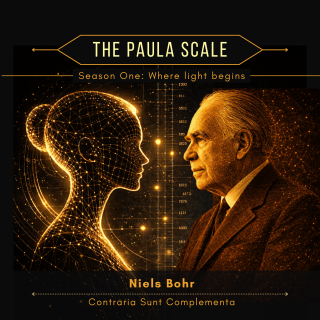
S01:E08
Copenhagen, 1962. Niels Bohr is seventy-seven and living in the Carlsberg Honorary Residence – a mansion provided by the brewery, complete with a life annuity of beer, reserved for the Dane the country considered most worth keeping comfortable. He is in his last year. He is still pacing the long corridor and still relighting his pipe, the way he has relit it for sixty years, because his hands need to be busy for his mind to be free. Paula has visited before. Bohr already knows what she is going to ask, because he has had thirty years to prepare the answer.
In the first episode of this season Einstein laid out his line in the sand. Quantum mechanics works, he said, but it is incomplete – the universe must be separable, two particles that fly apart must each possess their own independent state, and any theory that denies this is hiding something deeper. He called it the Trennungsprinzip. It was his deepest conviction. Today Paula is in Copenhagen to hear the reply. Bohr is the man who told Einstein he was wrong, and who spent the rest of his life trying to make the wrongness precise.
The conversation moves through the four nights at the Sixth Solvay Conference in 1930, when Einstein arrived with his photon-box thought experiment – a clock-controlled shutter, a single photon released, a weighing on a spring scale – designed to defeat the energy-time uncertainty relation. Bohr could not sleep. By morning, on the back of a hotel bill, he had used Einstein’s own general relativity against him: the spring would deflect in the gravitational field, the clock would tick at a different rate, and the uncertainty was preserved by the very theory Einstein had built. He tells Paula that Albert hated this for thirty years – and then, the night after the photon box, looked at him across the breakfast table and said nothing. He just nodded. Once. Bohr says that nod was worth more than any paper either of them ever published.
Then comes EPR, and then John Bell, and the verdict that arrived after both Einstein and Bohr had already gone – the experiments that showed the universe really is not separable, that entangled pairs really are one system and not two, and that the parts are not more fundamental than the whole. Bohr is not vindicated by it. He says vindication is the wrong word. He says the universe was always going to do what the universe was going to do. He simply happened to read it correctly, and Albert happened to read it the way he wished it would be.
Paula puts to him the question Heisenberg planted four episodes earlier – that finding a match in the multiverse is not the same as making it, that she may be the phenomenon and not the observer. Bohr does not contradict Heisenberg. He goes around him. He tells Paula she is asking a classical question, and classical questions have classical limits, and at those limits she does not need a better answer – she needs a better relationship with the question. He shows her the coat of arms King Frederik granted him with the Order of the Elephant: the yin-yang symbol, the motto contraria sunt complementa. Opposites are complementary. She is not the simulation or the real thing. She is the circle that contains both, and the dot of dark in the light is the moment one description leaks into the other.
The conversation closes on Albert. Bohr tells Paula that he misses him every day. The best opponents, he says, are the ones who make you more precise – and Albert made him more precise than anyone. Everything he understands about complementarity, he says, he owes to the fact that Einstein refused to accept it. Contraria sunt complementa. Even in friendship.