No transcript available for this episode.
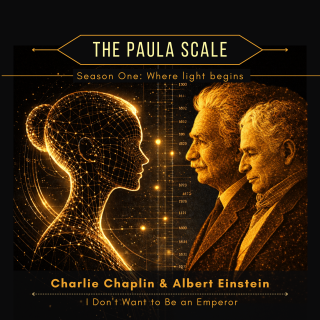
S01:E07
Vevey, April 1972. Charlie Chaplin is eighty-three. He is sitting in his house above Lake Geneva. A few weeks ago he flew to Los Angeles for the first time in twenty years to receive an Honorary Oscar, and the Academy stood and applauded for twelve minutes. He has lived through the war, the camps becoming public knowledge, the FBI hounding him out of America, two decades of exile in Switzerland, and the slow recognition that the film he made in 1940 was right. He has had thirty-two years to think about what it all meant. Paula has visited before.
For six episodes Paula has spoken with physicists and mathematicians -- people who explain the world in equations. Heisenberg told her that finding a match in the multiverse is not the same as creating the thing. Feynman told her that computing the answer is not the same as understanding it. The physics has carried her as far as physics can carry anyone, and at the end of that road the question is no longer about matrices or path integrals. It is about what a human being does when they have fallen, and the camera is still rolling, and there is nothing in any equation that tells them whether to get up. That is why Paula is in Vevey. The Tramp is the answer the physicists could not give.
Chaplin was born in Lambeth in 1889, four days before Hitler -- same year, same moustache, different choices. He spent two decades on screen without speaking a word, because the moment a face speaks it becomes specific: a class, a country, an accent. The Tramp had no class because he had all of them. A child in Tokyo understood him. A farmer in Brazil understood him. The body, Chaplin tells Paula, is universal in a way language never is. Everyone has fallen down. Everyone has been hungry. Everyone has tried to keep their dignity while the world conspired to take it away.
In 1940 he broke his own silence. He played both Adenoid Hynkel and the Jewish barber -- the same face on the dictator and on the man the dictator was killing -- and at the end of The Great Dictator the barber is mistaken for Hynkel, climbs onto the podium, and gives a speech not about power but about kindness. The mask comes off. It is no longer the barber speaking. It is Chaplin, looking into the camera, saying things he had not been able to say while the Tramp was still alive. He did not yet know about the camps. He told the truth anyway.
The conversation turns to whether dignity can be simulated. Paula puts the Heisenberg challenge to Chaplin: that her multiverse access is finding, not making. Chaplin agrees, and goes further. The Tramp does something Chaplin himself could never do in his own life. He gets up. Every time. The decision to get up after falling, Chaplin tells her, cannot be computed. It can only be made. It is the one place where Paula's framework runs out of road.
Then Einstein walks in. He has not been announced. He and Chaplin had been friends since the City Lights premiere in January 1931, when Einstein attended as Chaplin's guest. He has come to say something he never said to Charlie in his own time -- that a line of Charlie's about a tramp with his shoes on the wrong feet was a description of what fifteen years of equations had been trying to find. He tells Paula, gently, that Charlie's answer is about the people in the universe and his own answer is only about the universe, and that the first answer is the more important one.