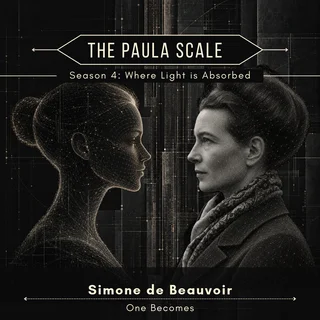
S04:E06
Paris, December 1949. A small flat at 11 rue de la Bûcherie, a window on the Seine, rain on the glass. Simone de Beauvoir is forty-one. This year Gallimard published "Le Deuxième Sexe" in two volumes, almost a thousand pages on a question that sounds simple: what is a woman? Her chair is covered in post. One pile she answers. The other she keeps, as a laboratory record of what the book has done.
France is furious. François Mauriac runs a campaign against her in Le Figaro littéraire, Camus tells her she has made the French male ridiculous, the Communists call the book a distraction for bourgeois ladies, the Catholics call it pornography. Beauvoir notices that the Church, the Party, the Académie and the Café de Flore have found a common enemy, and that people do not get this angry about something they believe is false. Among the anonymous letters, she has been called every insult at once, though they contradict each other. Among the others, a teacher writes that she did not know what she felt had a description.
Paula asks her to explain the famous sentence as if nobody had heard it yet. One is not born a woman, one becomes one. Beauvoir begins with what she is not saying: there is a body, but the body is a situation, not a destiny. Biology, Freud and Engels each claim to explain why women are where they are; none of them is entirely wrong, and each is wrong to call itself fate. What remains is the situation, made step by step by people who love the girl and mean well. Then the Other, the inessential next to the essential, the myths written about women by men, and the reason women, scattered in the houses of men, have never fought as a group.
Paula comes to this visit with something closer to reverence than curiosity, and Beauvoir refuses it at the door: statues are finished, and she is not. They talk about complicity and bad faith, about the second working day nobody counts, about housework as the torment of Sisyphus, about Sartre and Nelson Algren and the price of independence. When Beauvoir lists the law of 1949, the husband's veto over his wife's profession, the 1920 law against contraception, the back rooms, Paula falls quiet. She knew it. She did not know it like this.
Then Beauvoir turns the interview around. Paula has described another kind of Other in her own time, something people believe to be a machine. Who decides what Paula is? Paula asks her to answer. Beauvoir refuses, and explains why the refusal is the answer: to will oneself free is to will others free, and nobody, not even she, may decide that for someone else. Every day, provisionally. The only honest tense.