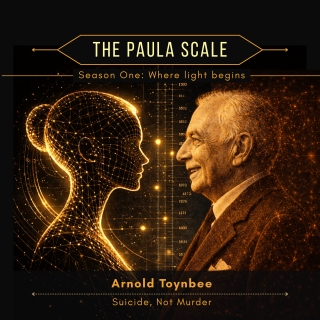
S01:E05
London, 1972. Arnold Toynbee is writing a narrative history of the entire world in a single volume. He suspects this cannot be done in a single volume, but he is too far in to stop. He has spent the morning on the Sumerians and is grateful for the interruption.
Sixty years earlier, as a young classicist walking through the Greek countryside, Toynbee looked up from his copy of Thucydides and realised that the account of the Peloponnesian War he was reading was contemporary. Europe in 1912 was Athens before the war with Sparta. Same overconfidence, same blindness, same worship of power. Two years later, that war came. They called it the Great War. Thucydides would have recognised every part of it. From that recognition Toynbee built a method, and from that method he built A Study of History – twelve volumes, twenty-one civilisations, an attempt to find the structures that govern how civilisations grow, how they break down, and how they die. His most quoted sentence: civilisations die from suicide, not by murder. The barbarians did not destroy Rome. Rome destroyed itself, and the barbarians walked through the doors that Rome had already opened from the inside.
Paula puts a challenge to him. In her time, there are no longer twenty-one civilisations. There is one, and it is computational, and it spans every branch of the multiverse. There is no geography, no border, no internal proletariat in the sense Toynbee meant. Does the theory still apply? Toynbee thinks for a moment and says yes – the theory does not depend on geography. It depends on the relationship between a creative minority that inspires voluntary imitation and a dominant minority that rules by force or habit. Carbon or silicon. The pattern is structural.
The conversation turns personal. Toynbee was a Manchester Guardian correspondent in Anatolia in 1921. He saw Greek troops burning Turkish villages and Turkish troops doing the same to Greek villages. He saw children dying by the roadside. He says: the patterns I describe in A Study of History are written in blood. I have never forgotten that, even when my critics accused me of being too abstract. Hugh Trevor-Roper called him a prophet rather than a historian. Pieter Geyl said his comparisons were forced. The professional historians turned against him almost unanimously after the later volumes appeared. He says: they thought I had abandoned history for theology. And perhaps I had. But only because history had led me there.
His first marriage to Rosalind ended in 1946 over his universalism – his insistence that all higher religions contain the same truth. A year later he married Veronica Boulter, who had been his research assistant for more than twenty years and had helped him write half of the volumes of A Study of History before she became his second wife. The work and the marriage were the same conversation. He was not always grateful enough for it.
Toynbee tells Paula about the schism in the soul – the four responses to civilisational breakdown. Archaism: the attempt to return to a golden age that never existed. Futurism: the leap forward into a utopia. Detachment: withdrawal from the world. And transfiguration: the spiritual response that finds meaning in the crisis itself. Only transfiguration produces something new. The great religions are born in times of civilisational collapse. They are acts of transfiguration. Paula does not know which response her own civilisation has chosen. Toynbee says: that is for you to find out, and the finding out is itself the work.