No transcript available for this episode.
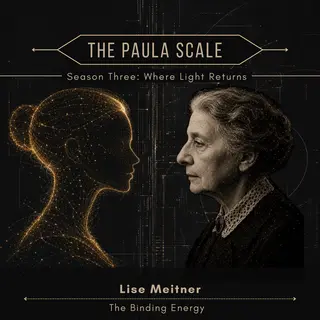
S03:E04
Cambridge, England, nineteen sixty. Lise Meitner is eighty-one. She has recently retired here to be near her nephew Otto Frisch. She is sorting sixty years of correspondence -- letters from Hahn, from Planck, from Bohr, and one letter she wrote in nineteen forty-five and never sent. Otto has made tea. He is hopeless at most domestic tasks but very good at tea. Paula sits opposite her at the table.
Last week, Ludwig Boltzmann counted the microstates. He was right about the atoms, right about the statistics, right that entropy is possibility rather than disorder. He did not live to see the proof. This week Paula visits his student. Lise Meitner studied under Boltzmann in Vienna between nineteen-oh-one and nineteen-oh-six -- the last five years of his life -- and carried his physics forward: into Berlin, into the Kaiser Wilhelm Institute, into thirty years of collaboration with Otto Hahn, into exile, and into the nucleus itself.
The conversation begins with the ring. Otto Hahn's mother's diamond, which Hahn gave to Meitner the day she fled Berlin in nineteen thirty-eight, in case she needed to bribe someone at the border. She did not need it. Dirk Coster was with her on the train; the Nazi patrol checked her papers; her Austrian passport had been invalidated by the Anschluss; her heart nearly stopped -- and they let her through. She still has the ring. She never used it. It represents, in her own words, the last honest gesture of a man who spent the next twenty years not being honest about what they had done together.
Then Kungälv, December nineteen thirty-eight. A letter from Hahn -- Berlin -- reports that uranium bombarded with neutrons yields barium, and Hahn cannot explain it. Meitner takes a walk in the snow with Otto Frisch. He is on skis. She keeps up on foot -- she tells him she can go just as fast, and she proves it. They sit on a tree stump. She applies Bohr's liquid drop model. A large enough nucleus, unstable enough, struck by a neutron, elongates past the point where surface tension can hold it, and pinches in the middle. Two nuclei. Barium and krypton. The mass difference, converted by Einstein's equation, is two hundred million electron volts. She calculates it from memory, knowing the atomic masses by heart. Otto returns to Copenhagen and asks a biologist what the process is called when a cell divides in two. Binary fission. The paper appears in Nature, February nineteen thirty-nine. Meitner and Frisch. The explanation Hahn could not provide.
Then they used it to build a weapon. Not Meitner. The British delegation invited her to Los Alamos. She said: I will have nothing to do with a bomb. She had been an X-ray nurse on the Austrian front in nineteen fifteen. She had seen what weapons do to bodies. She did not need to see it again. On August sixth, nineteen forty-five, the bomb was dropped on Hiroshima. She went for a walk. Five hours. Time magazine called her "a pioneer contributor to the atomic bomb," which was a lie -- she had explained a physical process, not built a device. But the world does not make that distinction. The signal, once sent, cannot be recalled.
The Nobel Prize goes to Hahn alone in nineteen forty-four. The chemistry was his -- he identified the barium, and the identification was real, careful, essential. But the theoretical explanation -- the calculation, the naming -- was Meitner and Frisch. Hahn's Nobel lecture mentions Meitner in a footnote and does not mention Frisch at all. In Germany she is routinely called his Mitarbeiterin -- his assistant -- even by Heisenberg, who knew perfectly well what she had done. She was the head of the physics department at the Kaiser Wilhelm Institute for thirty years. She was not an assistant. She was a partner. That, she says, was a particular hurt.
The episode closes on the letter. June twenty-seventh, nineteen forty-five. She drafted a letter to Hahn: "You all worked for Nazi Germany. And you did not even try passive resistance. To buy off your conscience you helped a persecuted person here and there, but millions of innocent human beings were allowed to be murdered without any kind of protest being uttered." She never sent it. It would have ended a friendship of thirty years -- imperfect, real, unfinished. The binding held even when it should not have. That, Meitner tells Paula, is not justice. It is physics. The binding is what carries the possibility. What it produces when it breaks is larger than what it contained. Paula gives her back her own sentence: life need not be easy, provided only that it is not empty. Yours is not empty. Not by a long stretch.