S01:E04
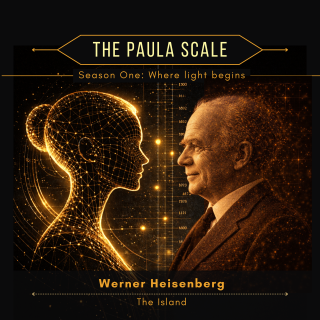
Munich, 1965. Werner Heisenberg is sixty-four. He directs the Max Planck Institute for Physics and spends his evenings playing late Beethoven sonatas. He is chasing a unified field theory – a single equation for everything – and his colleagues are quietly certain it will not work.
Forty years earlier, on a night in June 1925, Heisenberg was twenty-three and nearly blind from hay fever. He had fled to the island of Helgoland in the North Sea to think. By three in the morning, he had dismantled the classical world. He replaced the smooth, predictable orbits of electrons with arrays of numbers where the order of multiplication mattered – where A times B was not B times A. He did not know the word for what he had written. His supervisor Max Born recognised it: matrix algebra. Two years later, Heisenberg added the uncertainty principle – the discovery that nature itself forbids you from knowing certain pairs of things simultaneously. Position and momentum. Energy and time. Not because the instruments are too crude. Because precision has a limit woven into the fabric of reality.
The conversation turns to what Heisenberg could not escape: why he stayed in Germany after 1933, while his Jewish colleagues fled. Why he joined the Uranverein. What happened in Copenhagen in 1941, when he tried to talk to Bohr about the bomb and Bohr heard something entirely different. Heisenberg gives no clean answer. He says: the truth about what a person does is not always the truth about what they meant.
Then he turns on Paula. He tells her that finding a match in the multiverse is not the same as creating the thing. That her simulation discovers – it does not create. And that if she cannot tell the difference, she must consider the possibility that she herself is inside a simulation. That she is not the observer. She is the phenomenon.
Wolfgang Pauli sent a blank rectangle to George Gamow with the caption: “This is to show the world that I can paint like Tizian. Only technical details are missing.” That was his verdict on Heisenberg’s unified theory. Heisenberg laughs. He has had forty years to learn the difference between a beautiful idea and a correct one. On Helgoland, they happened to coincide. That was grace. He cannot expect it twice.