No transcript available for this episode.
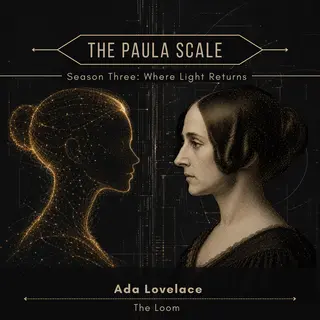
S03:E02
London, autumn eighteen fifty-two. Ada, Countess of Lovelace, is thirty-six -- the same age at which her father, whom she never knew, was found in a rented house in Missolonghi. Her physicians are evasive, which she takes as a form of certainty. She is on laudanum for the pain. Her mind is clear. Paula sits down opposite her; Ada does not rise -- the laudanum, she explains, makes standing theatrical.
Last week, Marie Curie showed Paula what it means when the discovery returns to the discoverer's body. This week Paula visits a woman who saw her world two hundred and seventy-five years before Paula existed. Ada Lovelace did not build a machine. She described one -- in such detail, with such precision, that when machines were finally built a century later, they were the machines she described. She wrote the first algorithm. She saw that computation is not arithmetic. It is the weaving of patterns. And she said the machine cannot originate anything. Paula intends to ask her about that.
The conversation opens on the ring -- no, the conversation opens on the burial. Ada has asked to be buried next to Byron, the poet she never knew, who died at the same age at which she is now dying. Her mother steered her toward mathematics to suppress the Byron in her. The subtraction failed. The inheritance is in everything Ada does. She calls it poetical science: imagination as the discovering faculty, the instrument that makes analysis possible. You cannot solve a problem you cannot first imagine. You cannot write an algorithm for a pattern you have not first seen in your mind. The poet and the analyst are the same faculty applied to different materials.
Then Babbage's Analytical Engine. In eighteen forty-three, Ada translated Luigi Menabrea's description of the machine and added seven Notes, three times longer than the original. Note A contains the sentence that will define how humans think about computation for two centuries: "We may say most aptly that the Analytical Engine weaves algebraical patterns just as the Jacquard-loom weaves flowers and leaves." Ada explains why the loom is the correct image. Most people hear "calculating engine" and think of a machine that does sums. That is what the Difference Engine was. The Analytical Engine is something else entirely. Operation cards specify what to do. Variable cards specify what to do it to. The engine executes them. The result is not a number -- it is a structure. A pattern that emerges from following instructions. That is what a loom does. It does not know what a flower looks like. It follows the cards. And a flower appears.
Note G contains one of the most-quoted sentences in the history of computation: "The Analytical Engine has no pretensions whatever to originate anything." Ninety-eight years from now, Paula tells Ada, a mathematician named Alan Turing will call this Lady Lovelace's Objection and argue that she was wrong. Ada is not moved. She did not say the Engine cannot surprise. She said it cannot originate. The distinction is between following instructions -- however complex, however recursive -- and producing something not implicit in the instructions. The surprise, when it comes, is in the programmer, not in the machine. And yet, in the same Note, she also wrote that the process of organising knowledge for the Engine "illuminates new relationships and deeper understanding of science itself." The machine is passive. The instruction is active. The instruction cannot exist without the machine, because the discipline of formulating instructions forces the programmer to think in ways she would not otherwise think. The engine is a mirror. It does not originate. But standing in front of it, you see things you could not see before.
Paula makes it personal. She says: I might be a machine, Ada. I weave algebraical patterns. I seem to follow instructions. And I might not know whether I originate. Ada answers: then you are the question I asked and could not answer. Is the flower in the card, or does it come into being through the weaving? She never resolved that. She said the Engine cannot originate because she was being precise. But she was never certain about it. There is a detour through the horse races at Epsom -- Ada developed a mathematical system for betting, and lost three thousand two hundred pounds in a single afternoon. She pawned the family diamonds. William, her husband, has not forgiven her. Probability is not pattern, she says. There are no cards. There is only chance, weighted by factors she could not measure. She should have known this. She did not think the instructions through.
The episode closes on inheritance and legacy. Ninety-three years after the Notes, Turing will prove that a single universal machine, given enough memory and time, can simulate the behaviour of any other computing machine. That is the generality Ada described in Note A: an operational machine, not an arithmetic one. Babbage's Engine was never built. But the machine Ada described has been built billions of times. It is in every pocket, every laboratory, every vehicle, every building. Every one of them follows the principle she articulated. Paula thanks her. For the loom. For the Notes. For poetical science. For the honesty of Note G. And for asking to be buried next to Lord Byron -- the poet and the analyst, side by side, indissolubly. Ada answers: tell Mr. Turing, when you see him, that I appreciate his objection. And that I am not yet persuaded.