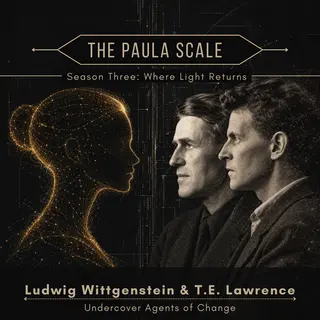
S03:E09
Two rooms, two years, both in England. Cambridge, nineteen twenty-nine. Ludwig Wittgenstein has just returned to Trinity after six years away. He came in nineteen eleven at twenty-two, the son of one of the wealthiest industrialists in Austria-Hungary, meaning to study engineering; within a week he was in Russell's rooms arguing about the foundations of logic. He gave away the entire family fortune, wrote the Tractatus Logico-Philosophicus in the trenches on the Italian front, published the book that ended philosophy as it had been done, and then walked away -- into a village school in rural Austria, a monastery gardener's job, a house designed for his sister. And now he is back, about to dismantle the framework the Tractatus set out. Dorset, nineteen thirty-two. T.E. Lawrence is Aircraftman Shaw, mechanic. He has been in the ranks for nine years, hiding under two different service names in order to be forgotten. He is translating Homer at Clouds Hill, a cottage without electricity or running water, and rebuilding the manuscript of Seven Pillars of Wisdom, which he lost on Reading station in nineteen nineteen and rewrote from memory.
Paula brings them together because they arrived at the same operation from opposite ends of morality. Wittgenstein took analytic philosophy to its logical extreme, showed that most of what philosophy had ever tried to say could not meaningfully be said, and left. Lawrence took the British Empire's game in Arabia to its extreme -- promised the Arabs independence, delivered the revolt, then found out the Sykes-Picot agreement had already divided the territory between France and Britain -- and left. Both broke the paradigm from inside by taking it further than anyone was willing to go. Both refused what the breakthrough earned them. Both retreated to huts. Both spent the rest of their lives working on something that would either never be finished or that no one would understand.
The conversation opens on origins. Ludwig on the Palais Wittgenstein in Vienna, where Brahms and Mahler played, where his father hosted the empire's industrialists, where three of his brothers took their own lives; on the wire-mesh-and-electromagnet machinery of the Tractatus, built out of Russell's logic in a Norwegian hut and finished in a prison camp at Cassino. Thomas on Oxford as a schoolboy, the eleven-hundred-mile walk through Syria mapping Crusader castles, the archaeological dig at Carchemish that ran alongside British intelligence work, the ride into Damascus in nineteen eighteen ahead of Allenby -- and the discovery, weeks later, that the Sykes-Picot map had already carved up the ground he had promised. What they share is the boat manoeuvre: use the boat to cross the river, then leave the boat behind. Wittgenstein's ladder in the Tractatus. Lawrence's uniform in the desert. Different rivers, same trick.
Then the huts. Ludwig on the hut at Skjolden, Norway -- built for him in nineteen fourteen, on a fjord no one could reach without asking a boatman -- where the Tractatus became possible because there was nobody to talk to. Thomas on Clouds Hill in Dorset, two rooms, a bookshelf ceiling to floor, a gramophone, no electricity, no running water -- where he translates Homer and rewrites Seven Pillars from the memory of the manuscript he lost on Reading station. Wittgenstein points out that Homer's Odyssey and Lawrence's Seven Pillars are the same book: a soldier trying to come home from a war he does not know how to leave behind. Neither man made it back. Both wrote about the trying.
Paula asks about the refusals. The Cambridge fellowship. The knighthood. The wealth. The command. Wittgenstein and Lawrence enlisted in armies and then in ranks below their capabilities, gave away titles, chose menial work over prestige. Not because the work was noble but because the noise of prestige made the work impossible. Paula puts it to them: they were both operating inside institutions they had reasons to distrust, and used the institutions as cover while doing something else. Undercover agents of change, in exactly the phrase Lawrence dislikes and Wittgenstein finds accurate. What they were changing was not the institution. It was the language the institution used to describe itself. Wittgenstein by showing what language cannot do. Lawrence by leaving a report on his own dishonesty that no one in his time was willing to read straight.
The episode closes on the boats they left behind, and on the manuscripts they never stopped rewriting. Wittgenstein has spent the last three years dismantling the Tractatus and is beginning to keep the notes at Trinity that will become the Philosophical Investigations. Lawrence has rewritten Seven Pillars three times from memory. Neither knows he is at the beginning of the final work; both proceed as if they were. Paula thanks them. For Skjolden and Clouds Hill. For the boat that was used and left. For the sentence that ends "whereof one cannot speak, thereof one must be silent" -- which is not, as most readers think, a prohibition, but a permission. For the Arab revolt that succeeded, and the promise it kept faith with by being written down as a failure. And for the two men who took the paradigm as far as it would go, and then walked out through the door they had built in it.