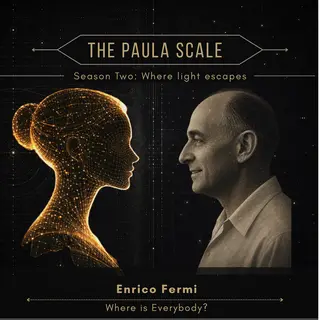
S02:E06
Chicago, September 1954. Enrico Fermi is fifty-three and has just returned from teaching the summer school at Varenna on the Italian lakes. He still walks to the office at the University of Chicago every morning. He derived the statistics of half-integer-spin particles in 1926, calculated the theory of beta decay in 1933, built the world's first nuclear reactor under the squash court at Stagg Field in December 1942, and dropped scraps of paper at the Trinity test to estimate the yield of the first atomic bomb. He got it right to within a factor of two. From scraps of paper. The colleagues call him the Pope, not because he is infallible -- though they believe he is -- but because when disputes arise in the field, they are referred to him as if to a papal authority. Four years ago, in the summer of 1950, he was walking to lunch at Los Alamos with Edward Teller, Emil Konopinski, and Herbert York. They had been laughing about a cartoon in the New Yorker that showed little green men stealing trash cans. The conversation moved on. They reached the canteen, sat down, talked about something else entirely. And then Fermi -- out of nowhere, mid-sentence on a different topic -- said: where is everybody?
Every person at that table immediately knew what he meant. The universe is older and larger than us by orders of magnitude. There ought to be other civilisations. There ought to be signals. Probes. Reasons to think we are not alone. There are none. Fermi did not phrase a paradox. He phrased a question. And the question -- once it is in your head -- does not leave.
Last week Feyerabend told Paula that no single method has ever governed science -- that every rule was violated by the discoveries it was supposed to explain, and that reality exceeds every framework. Today Paula visits the man whose method was the smallest possible -- a pencil, a paper scrap, an estimate to within a factor of two, and the discipline never to mistake the framework for the world. Fermi made an estimate by dividing two numbers in his head and threw away anything that was not a power of ten. He taught his students at the University of Chicago to do the same: a Fermi problem is one you can solve to within a factor of two using nothing but reasoning and the back of an envelope. How many piano tuners are there in Chicago. How much energy is released by the fission of one gram of uranium. What yield should we expect from this bomb at this distance. Twelve and a half kilotonnes. The actual answer was twenty. Off by less than a factor of two. From paper scraps.
The conversation moves to Chicago Pile-1. The squash court under the West Stand of Stagg Field. Three hundred and sixty tons of graphite, forty-five tons of uranium oxide, five and a half tons of uranium metal, by hand, by graduate students, in a city of three million people, with no shielding and no containment vessel. December second, 1942. The last control rod pulled at three twenty-five in the afternoon. The reaction ran for twenty-eight minutes and was shut down by the Italian navigator who decided he had seen enough. Arthur Compton telephoned James Conant. He said: the Italian navigator has just landed in the New World. Conant asked: how were the natives. Compton said: very friendly.
The paradox returns. Fermi tells Paula he has no answer to his own question, only candidates. Maybe intelligent life is rare. Maybe it is common but short-lived. Maybe civilisations destroy themselves before they reach the stars -- and he has reasons to think about that, having helped build the device that makes such self-destruction possible. He wrote in October 1949, with Isidor Rabi, that the hydrogen bomb is necessarily an evil thing considered in any light, and the fact that no limits exist to the destructiveness of this weapon makes its very existence and the knowledge of its construction a danger to humanity as a whole. The General Advisory Committee report. Minority addendum. Fermi and Rabi signed it. Truman ignored it. This past April, Fermi testified for Oppenheimer in front of the Personnel Security Board -- the only press conference of his life, called to denounce the revocation of the clearance. Robert was wrong about some things; he was not a traitor.
The episode closes on Giulio. In 1915, when Enrico was fourteen, his older brother Giulio died at fifteen from an anaesthesia accident during a routine throat operation. After the funeral, Enrico went to the secondhand book market at the Campo de Fiori in Roma and bought Andrea Caraffa's Elementorum Physicae Mathematicae of 1840, nine hundred pages in Latin, and read it from cover to cover. He did not say so at the time, but Segre wrote it down later: this is when Enrico decided to become a physicist. Paula puts it to him gently. He says: my brother died. The book was there. Maybe somewhere out there is a civilisation that lost a brother and found a book. Or maybe the silence Paula hears in the multiverse is the same silence he hears every day. He cannot tell her where everybody is. He can only tell her that the question, once asked, becomes the centre of everything.