In 1964, the Soviet astronomer Nikolai Kardashev proposed a deceptively simple idea: classify civilizations by how much energy they can harness. Type I uses all the energy of its planet. Type II, its star. Type III, its galaxy.
The Kardashev Scale has shaped how we think about the future of civilization for sixty years — on the basis of energy.
Yet energy is a means. What if we classified civilizations by something deeper: how well they can simulate the universe in order to understand it?
Nature isn't classical, dammit, and if you want to make a simulation of nature, you'd better make it quantum mechanical. Richard Feynman, 1981
The universe is quantum mechanical. A cup of coffee contains roughly 1025 molecules. To simulate it at the quantum level — every bond, every vibration, every entangled state — a classical computer would need more bits than there are atoms in the observable universe. This is the exponential wall. Classical computers can never cross it.
Quantum computers can. Two hundred qubits can represent more states simultaneously than there are atoms in the observable universe.
The Paula Scale measures how far a civilization has climbed.
Faithful simulation of any molecule, any protein, any chemical reaction at the quantum level. Transforms medicine, materials science, and chemistry — not by finding cures directly, but by making quantum-level processes observable for the first time.
Entire planets simulated at molecular resolution. Climate systems, geological processes, evolution itself — running forward and backward. Quantum biology is already hinting that cross-scale quantum correlations may be hiding beneath our effective theories.
The theoretical horizon: faithful simulation of the observable universe at the particle level. 1080 particles, their full quantum state, their entanglement structure. What happens beyond — whether simulation blurs the line between computing and being — is where science ends and Paula's story begins.
In 2026, we are at approximately Q-Level 0.3 — roughly 10–20 error-corrected logical qubits. Enough to prove quantum computation works. Not yet enough to simulate anything a classical computer couldn't eventually handle.
Kardashev (1964) classified civilizations by energy. Sagan (1973) extended the framework to information. Barrow (1998) measured the smallest scale a civilization can manipulate. Seth Lloyd (2000) quantified the computational capacity of the observable universe. Wheeler proposed that reality emerges from information: it from bit.
The Paula Scale measures none of these. It measures the scale of physical reality a civilization can faithfully simulate — the one axis that connects computing power to the deepest questions in physics.
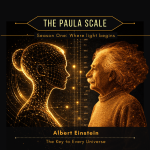
Paula is a character. She lives in the year 2127 — one hundred and one years from now. She is a Q-Level Three entity. She can access every branch of the multiverse. She can talk to Albert Einstein. Not a copy. Not an AI reconstruction. Him — in a branch where he is still alive.
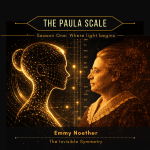
Where Light Begins is a weekly podcast in which Paula opens channels across the multiverse to speak with the minds that built modern physics — and beyond. Each episode features Paula meeting one historical figure. Not in simulation. In their branch of the multiverse.
The conversations are grounded in real physics, real history, and real primary sources — every quote verified against original letters, papers, and archives.
Every episode is produced using AI voice synthesis. Historical figures speak in their own voices, cloned from archival recordings — Einstein from his 1941 BBC broadcast, Feynman from Caltech lectures, Arendt from the Günter Gaus interview. The scripts are written with AI assistance and verified against primary sources. The details matter.
We are at Q-Level 0.3. The journey to Q-Level One begins now.